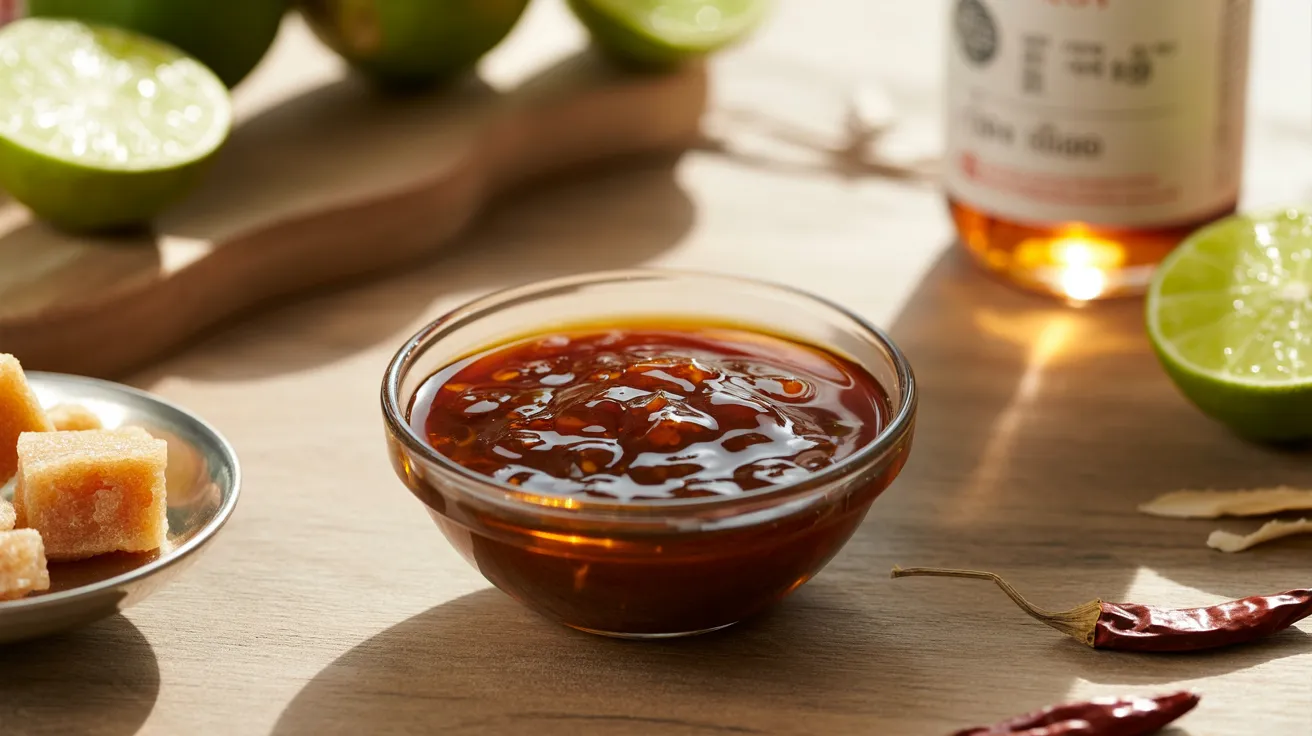
Getting the Thai pad thai sauce sweet sour balance just right is what separates a flat, one-note noodle dish from one that tastes like it came straight off a Bangkok street cart. This recipe teaches you exactly how to nail that Thai pad thai sauce sweet sour balance — bold tamarind tang, savory fish sauce depth, and just enough palm sugar sweetness — every single time. No guessing. No dumping and hoping. Just a reliable, repeatable sauce that works for four people and comes together in under ten minutes.
SERVES: 4 | PREP: 10 MIN | COOK: 5 MIN | TOTAL: 15 MIN
What Makes the Sweet Sour Balance in Pad Thai Sauce So Hard to Get Right
Most home cooks struggle with pad thai sauce because they’re working from vague recipes that say “add fish sauce to taste.” That’s not helpful when you’re new to Thai cooking.
The truth is, Thai pad thai sauce sweet sour balance is built on a ratio system. Tamarind gives sour. Palm sugar gives sweet. Fish sauce gives salt and umami. When those three hit the right proportions, your brain lights up. When they’re off, the whole dish falls flat.
This recipe gives you exact measurements to start — and then teaches you how to adjust by taste like a real Thai cook.
Ingredients
Sauce Base
| Ingredient | Amount |
|---|---|
| Tamarind paste (concentrate) | 3 tablespoons |
| Fish sauce | 2 tablespoons |
| Palm sugar (or light brown sugar) | 2 tablespoons |
| Oyster sauce | 1 tablespoon |
| Water (warm) | 2 tablespoons |
Optional Flavor Boosters
| Ingredient | Amount |
|---|---|
| Lime juice (fresh) | 1 teaspoon |
| White sugar | ½ teaspoon (only if needed) |
| Dark soy sauce | ½ teaspoon (for color depth) |
Step-by-Step Instructions
Phase 1: Prep Your Ingredients
Step 1 — Gather everything before you start. Set out all your sauce ingredients on the counter. Once you start cooking pad thai noodles, things move fast. Having your sauce ready to pour in saves you from burning your stir-fry while you’re still measuring.
Step 2 — Check your tamarind paste. Open your tamarind concentrate and look at it. It should be a dark brown, thick paste — similar to molasses. If yours came in a block (not pre-dissolved), you’ll need to soak a 2-inch piece in 3 tablespoons of warm water for 5 minutes, then press it through a strainer to remove seeds and fibers. The concentrate version skips this step entirely. Either type works fine.
Step 3 — Prepare your palm sugar. Palm sugar usually comes in solid discs or cylinders. Use a knife to shave or chop 2 tablespoons off the block. If it’s very hard, microwave it for 10 seconds to soften. Brown sugar works as a substitute — use the same amount.
Phase 2: Mix and Dissolve the Sauce
Step 4 — Combine tamarind and warm water. In a small bowl, mix the 3 tablespoons tamarind paste with 2 tablespoons warm water. Stir until the paste loosens and becomes pourable. Warm water helps it dissolve faster. Cold water can leave lumps that won’t blend into your sauce properly.
Step 5 — Add the palm sugar. Drop your 2 tablespoons of palm sugar into the tamarind mixture. Stir for about 60 seconds. The sugar doesn’t need to fully dissolve yet — it will finish dissolving when you heat the sauce.
Step 6 — Pour in the fish sauce. Add 2 tablespoons fish sauce to the bowl. Stir to combine. The mixture will smell strong right now — that’s completely normal. The smell softens significantly once cooked and tossed with noodles.
Step 7 — Add oyster sauce. Stir in 1 tablespoon oyster sauce. This adds a slightly sweet, thick body to the sauce that rounds out the sharp edges of the tamarind and fish sauce. Don’t skip this — it’s doing a lot of quiet work in the background.
Phase 3: Heat and Taste-Test the Sauce
Step 8 — Pour sauce into a small saucepan over low heat. Transfer your mixed sauce to a small saucepan. Set heat to low — you’re warming it, not boiling it. Boiling can make fish sauce bitter and concentrate the salt too fast.
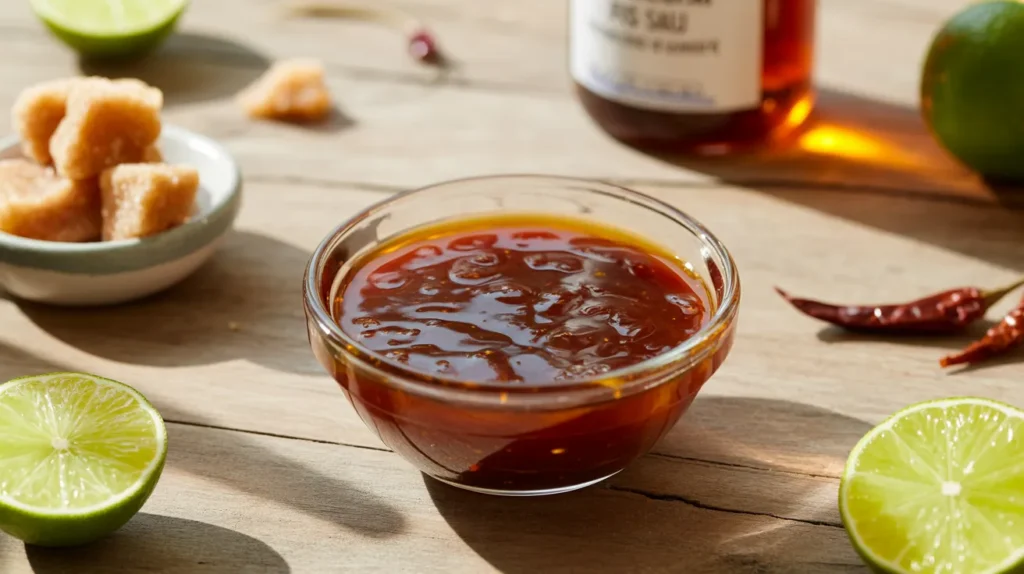
Step 9 — Stir constantly for 2–3 minutes. Keep stirring as it heats. You’ll see the palm sugar fully dissolve and the sauce will darken slightly and become glossy. This is exactly what you want. When it coats the back of a spoon, it’s ready.
Step 10 — Do the taste test (this is the most important step). Pull the pan off the heat. Dip a clean spoon in and taste a small amount. Here’s what to look for:
- Sour hits first — you should taste the tamarind tang immediately
- Sweet follows — the palm sugar should soften the sour within a second or two
- Salt lingers — fish sauce flavor should sit at the back, not punch you in the face
If the sauce tastes right to you at this point, you’re done. If not, go to Step 11.
Step 11 — Adjust the Thai pad thai sauce sweet sour balance. This is where you fine-tune. Use these adjustments:
- Too sour? Add ½ teaspoon palm sugar at a time. Stir and re-taste.
- Too sweet? Add a few drops of lime juice or a small splash of fish sauce.
- Too salty? Add ½ teaspoon palm sugar + ½ teaspoon water to dilute.
- Flat/bland? Add ½ teaspoon lime juice — it wakes everything up.
- Too pale in color? Stir in ½ teaspoon dark soy sauce for a richer amber color.
Step 12 — Return to low heat for 1 final minute after adjustments. After any tweaks, warm the sauce one more time for about 60 seconds on low heat. This re-integrates the flavors. Take it off heat and set aside until you’re ready to use it.
Phase 4: Use the Sauce in Your Pad Thai
Step 13 — Add sauce to your wok at the right time. When stir-frying pad thai, add this sauce after your noodles go in and have cooked for about 1 minute. Pour it evenly around the edges of the wok, not directly on top of the noodles. This lets the sauce hit the hot pan and caramelize slightly before coating the noodles. That’s what gives restaurant pad thai that slight sticky, glossy finish.
Step 14 — Toss noodles quickly once sauce is added. Once the sauce hits the wok, use tongs or chopsticks to toss everything together fast — about 30 to 45 seconds. You want every noodle coated but you don’t want to keep cooking too long or the sauce reduces too much and becomes too salty.
Chef’s Notes
Use tamarind concentrate, not tamarind powder. Powder is much more acidic and harder to control. Concentrate gives you a consistent, measured sour that makes balancing your Thai pad thai sauce sweet sour balance much easier.
Fish sauce brand matters more than you think. Tiparos and Megachef are mild and well-rounded. Cheaper generic brands can be sharper and harder to balance. If your sauce tastes “too fishy” after cooking, your fish sauce may be the culprit — try a different brand next time.
Make the sauce a day ahead. The flavors in Thai pad thai sauce sweet sour balance actually improve overnight in the fridge. The tamarind mellows and everything integrates. Make a double batch on Sunday and use it all week.
Room temperature sauce coats noodles better. Cold sauce from the fridge thickens up and doesn’t spread as evenly. Take your sauce out of the fridge 15 minutes before cooking for best results.
Nutrition Information (Per Serving — Sauce Only)
| Nutrient | Amount |
|---|---|
| Calories | 52 |
| Carbohydrates | 11g |
| Sugar | 9g |
| Protein | 1g |
| Fat | 0g |
| Sodium | 780mg |
Note: Sodium reflects fish sauce content. Reduce fish sauce by ½ tablespoon to lower sodium to approximately 560mg per serving.
Variations
1. Vegan Thai Pad Thai Sauce Sweet Sour Balance
Swap fish sauce for soy sauce + 1 teaspoon rice vinegar. Use the same amounts. Add a pinch of MSG (optional) to bring back the umami depth that fish sauce naturally provides. The sweet-sour ratio stays the same — just the salt source changes.
2. Spicy Sweet Sour Pad Thai Sauce
Add 1–2 teaspoons of Thai chili paste (nam prik pao) to the base sauce. This roasted chili paste brings a smoky heat that layers beautifully over the tamarind sour. Start with 1 teaspoon and adjust up. This version pairs perfectly with shrimp pad thai.
3. Extra Tangy Restaurant-Style Version
If you love the punchy sour version you get at Thai restaurants, increase tamarind to 4 tablespoons and add 1 teaspoon fresh lime juice at the end. This bright, acidic version works especially well with chicken. For more on tamarind-forward Thai sauces, check out this authentic pad thai sauce with tamarind and fish sauce — it goes deep on getting the most out of tamarind paste.
4. Dark and Smoky Drunken Noodle Crossover Sauce
Add 1 teaspoon dark soy sauce and ½ teaspoon oyster sauce to this base for a richer, darker sauce that works for both pad thai and spicy drunken noodles. If you want to take this further into basil-forward territory, the pad kee mao sauce Thai drunken noodles recipe uses a similar sweet-salty base with a bold chili twist.
Storage & Reheating
Refrigerator: Store sauce in a sealed glass jar or airtight container. It keeps for up to 2 weeks in the fridge. The flavor actually deepens after the first 24 hours.
Freezer: Pour into an ice cube tray and freeze. Pop the frozen cubes into a zip-lock bag. Each cube = approximately 1 tablespoon. Use within 3 months. Thaw at room temperature for 10 minutes before using.
Reheating: Warm gently in a small saucepan over low heat for 1–2 minutes. If it’s thickened in the fridge, add a small splash of water (½ teaspoon) and stir to loosen. Never microwave fish sauce-based sauces — it can make them taste metallic.
Troubleshooting
Problem 1: Sauce tastes too salty. This usually means too much fish sauce or the sauce reduced too much during heating. Fix it by adding ½ teaspoon palm sugar + 1 teaspoon warm water. Stir and taste again. The sugar takes the edge off salt without making the sauce sweet.
Problem 2: Sauce is too sour even after adding sugar. Your tamarind concentrate may be very strong. Next batch, start with 2 tablespoons tamarind instead of 3 and build up from there. For now, add ½ teaspoon more palm sugar and ½ teaspoon oyster sauce to round out the sharpness.
Problem 3: Sugar isn’t dissolving. Palm sugar needs heat to fully dissolve. If mixing cold, the sugar may not incorporate. Put the bowl in the microwave for 20 seconds, stir, repeat once. Or always mix over low heat in a saucepan as directed in Step 9.
Problem 4: Sauce looks too thin. Thin sauce doesn’t coat noodles well. Cook it on low heat for an extra 2–3 minutes, stirring constantly, until it thickens to the consistency of maple syrup. Don’t rush this with high heat or it will get too salty as it reduces.
Problem 5: Finished pad thai tastes flat even with the sauce. The issue is usually timing. If you added the sauce too early (before the noodles were in the wok) it burned off. Or if you added it too late (at the very end), it didn’t caramelize. Follow Step 13 exactly — add sauce after 1 minute of cooking noodles, around the edges of the wok.
Equipment Essentials
- Small saucepan (1–1.5 quart) — for heating and dissolving the sauce
- Small mixing bowl — for pre-mixing before heating
- Measuring spoons — accuracy matters when building Thai pad thai sauce sweet sour balance
- Whisk or fork — for breaking up tamarind paste
- Fine mesh strainer — if using block tamarind (to remove seeds and fibers)
- Tasting spoon — clean spoon for each taste test (non-negotiable)
- Glass jar with lid — for storing leftover sauce
No wok? A large non-stick skillet works fine for the final stir-fry step. Cast iron also works but gets very hot — reduce stir-fry time slightly.
Shopping List
Produce & Fresh
- Fresh limes (1–2 for juice)
Condiments & Sauces Aisle
- Tamarind paste / concentrate (look for a jar — Tamicon or A. Taste brands are reliable)
- Fish sauce (Tiparos or Megachef recommended)
- Oyster sauce (Maekrua or Lee Kum Kee)
- Dark soy sauce (optional, for color)
Asian / International Foods Aisle
- Palm sugar (in a bag or tube — golden brown color)
- OR light brown sugar (baking aisle substitute)
Spices & Baking
- White sugar (optional, only for fine-tuning)
5 Success Secrets for Perfect Thai Pad Thai Sauce Sweet Sour Balance
1. Always taste before it goes in the wok. Your sauce should taste slightly stronger than you want in the finished dish. Noodles absorb and dilute flavor. A sauce that tastes perfectly balanced in the bowl will taste mild once it’s tossed with rice noodles.
2. Start with less tamarind, build up. If you’re new to tamarind, start with 2 tablespoons for your first batch. You can always add more — you can’t take it out. Getting comfortable with tamarind intensity takes a couple of tries.
3. Warm water is your mixing tool. Any time your sauce feels too thick, too lumpy, or hard to stir, a small splash of warm water fixes it. Not cold water — warm. Cold water can cause the sauce to seize up slightly.
4. Let the sauce sit for 5 minutes after mixing. Give it a short rest before tasting. The flavors keep shifting for a few minutes after heat. Tasting immediately after the stove can throw off your adjustments because the salt hasn’t fully integrated yet.
5. Make double and freeze. This Thai pad thai sauce sweet sour balance recipe scales perfectly. Double or triple the batch and freeze in tablespoon-sized portions. Having sauce ready means pad thai is a 15-minute weeknight dinner instead of a 40-minute project.