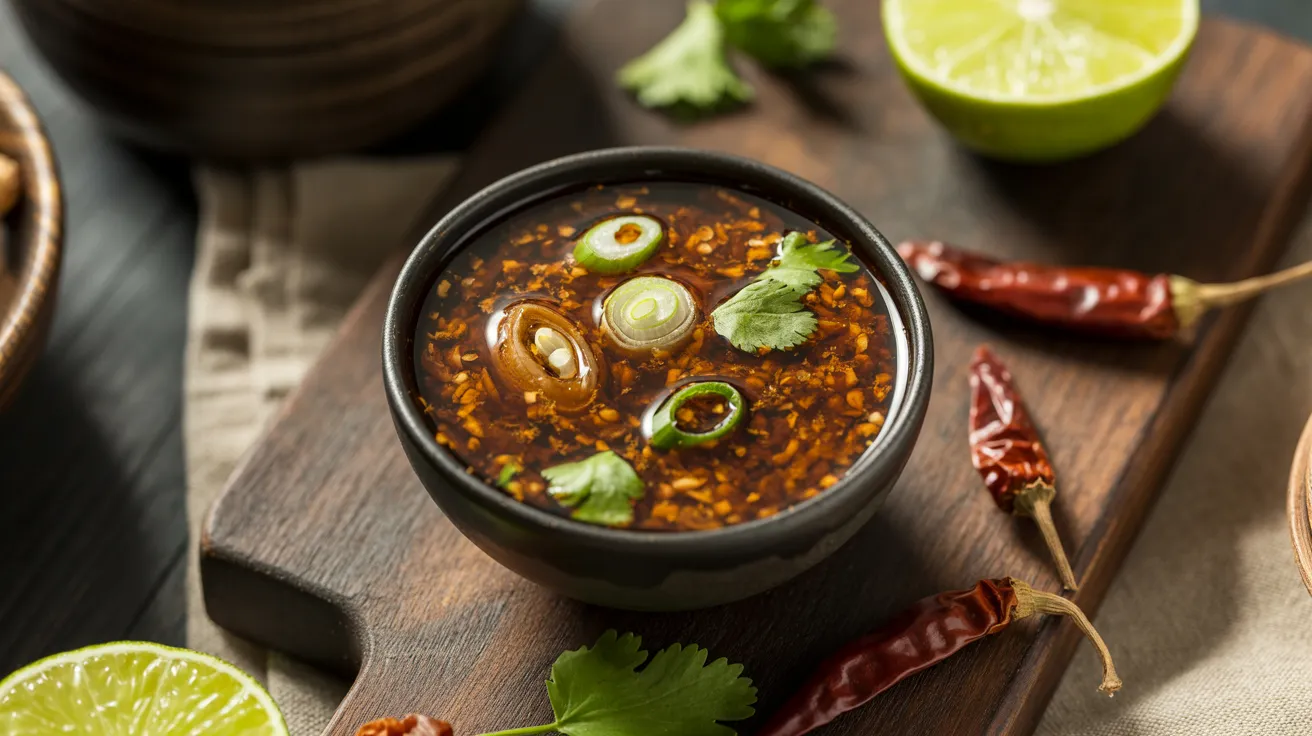
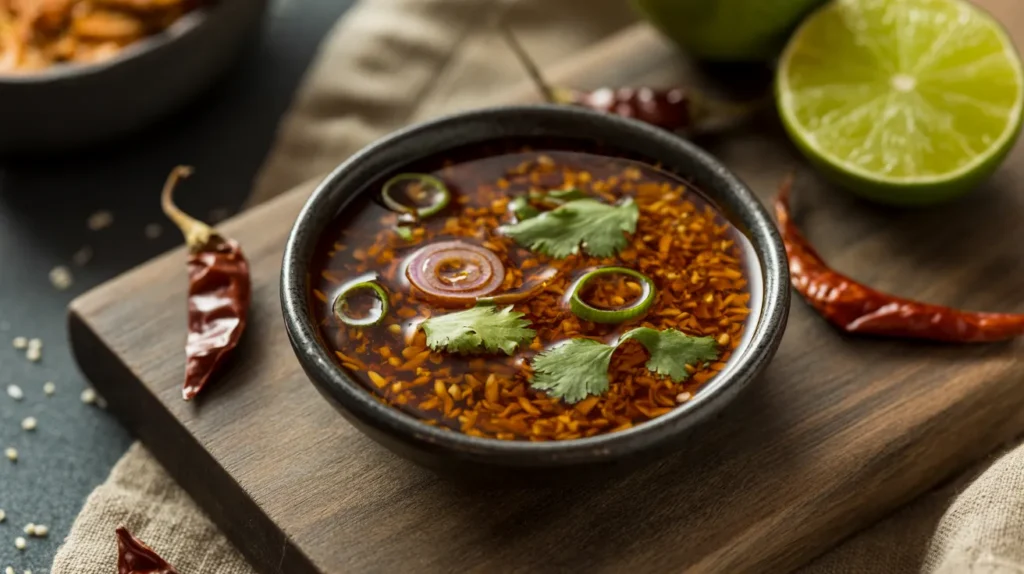
This Thai tamarind chili dipping sauce with roasted rice powder is the boldest, most addictive condiment you’ll ever put on your table. Known in Thailand as Nam Jim Jaew, this Thai tamarind chili dipping sauce with roasted rice powder hits every flavor note at once — smoky, tangy, spicy, and savory — with a nutty crunch from hand-toasted rice you make yourself. Street vendors in Isaan have been spooning it over grilled meats for generations, and one bite will tell you exactly why.
SERVES: 4 | PREP: 15 MIN | COOK: 10 MIN | TOTAL: 25 MIN
What Is Thai Tamarind Chili Dipping Sauce With Roasted Rice Powder?
This sauce comes from Northeast Thailand’s Isaan region. It is the classic partner for grilled beef, pork, and chicken. The roasted rice powder is what makes it special. It gives the sauce a slightly gritty, toasty texture that no other condiment can copy.
You make it fresh, you eat it fresh. That’s the Isaan way.
Ingredients
For the Roasted Rice Powder (Khao Khua)
| Ingredient | Amount |
|---|---|
| Raw jasmine rice (uncooked) | 3 tablespoons |
For the Dipping Sauce
| Ingredient | Amount |
|---|---|
| Tamarind paste (seedless concentrate) | 3 tablespoons |
| Fish sauce | 3 tablespoons |
| Fresh lime juice | 2 tablespoons |
| Palm sugar (or light brown sugar) | 1½ tablespoons |
| Dried chili flakes (prik bon) | 1–2 teaspoons |
| Shallots, peeled and thinly sliced | 2 medium |
| Green onions, finely sliced | 2 stalks |
| Fresh cilantro leaves | 2 tablespoons |
| Roasted rice powder (from above) | 1½ tablespoons |
Step-by-Step Instructions
Phase 1 — Toast and Grind the Rice Powder
Step 1 — Choose your pan. Use a small, dry skillet or wok. It must be completely dry — no oil, no water. Any moisture will make the rice steam instead of toast. A cast iron skillet works especially well here because it holds heat evenly.
Step 2 — Add the raw rice. Pour 3 tablespoons of raw jasmine rice into your cold, dry pan. Do not heat the pan first. Starting the rice in a cold pan gives you better control over the toasting speed.
Step 3 — Toast over medium heat, stirring constantly. Turn your burner to medium. Stir the rice every few seconds with a wooden spoon or spatula. You are watching for color change. After about 4–5 minutes, the rice will start turning light golden. Keep stirring — it goes from perfect to burnt very quickly.
Step 4 — Watch for deep golden color and a nutty smell. After 7–9 minutes total, the rice should look like light brown coffee grains — not white, not dark brown. You will smell a popcorn-like, nutty aroma. That is your cue. Pull the pan off the heat immediately.
Safety Tip: If the rice starts smoking or smells sharp and bitter, it is burning. Remove from heat right away and start over. Burnt rice powder will make your whole sauce bitter.
Step 5 — Cool completely before grinding. Pour the toasted rice onto a small plate or bowl. Spread it out in a thin layer. Let it cool for at least 5 minutes. Grinding hot rice traps steam and makes the powder clump.
Step 6 — Grind to a coarse powder. Add the cooled rice to a small food processor, spice grinder, or mortar and pestle. Pulse or pound until you get a coarse, sandy texture — not fine flour. You want small bits you can feel when you eat the sauce. This texture is the whole point. Set aside.
Phase 2 — Prepare the Fresh Ingredients
Step 7 — Slice the shallots. Peel 2 medium shallots and slice them as thin as you can — paper-thin rounds or half-moons. Thin shallots soften slightly in the acidic sauce and taste sweet, not harsh. Thick-cut shallots stay sharp and bitter.
Step 8 — Slice the green onions. Trim the root ends off 2 green onion stalks. Slice them into thin rings, using both the white and green parts. Set aside.
Step 9 — Pick your cilantro leaves. Pull 2 tablespoons of cilantro leaves from the stems. Rough-chop them once or twice — you want recognizable leaf pieces, not a paste.
Phase 3 — Mix the Sauce Base
Step 10 — Combine the liquid ingredients. In a medium mixing bowl, add:
- 3 tablespoons tamarind paste
- 3 tablespoons fish sauce
- 2 tablespoons fresh lime juice
Stir with a spoon until fully mixed. The tamarind paste is thick, so take 30 seconds to work it smooth into the fish sauce. No lumps should remain.
Beginner Note: Tamarind paste from a jar is easy to use. If you only have a block of dried tamarind pulp, soak a golf ball-sized piece in ¼ cup warm water for 10 minutes, then press it through a strainer. Use the liquid that passes through.
Step 11 — Add the sugar. Add 1½ tablespoons palm sugar (or light brown sugar if palm sugar isn’t available). Stir well for about 1 minute until the sugar fully dissolves. Taste the base. It should taste tart, salty, and slightly sweet all at once. This is your flavor foundation.
Step 12 — Add the chili flakes. Stir in 1–2 teaspoons dried chili flakes. Start with 1 teaspoon if you are sensitive to heat. The full 2 teaspoons gives you a medium-hot sauce, which is closer to the traditional Isaan version. You can always add more chili at the end.
Phase 4 — Build and Finish the Sauce
Step 13 — Add the fresh ingredients. Add the sliced shallots, green onions, and cilantro into the sauce bowl. Stir everything together gently. The acid from the tamarind and lime will start to slightly soften the shallots right away.
Step 14 — Add the roasted rice powder. Stir in 1½ tablespoons of your freshly made roasted rice powder. Mix it in well. Watch how the sauce thickens slightly and gets a light, grainy texture. This is exactly what you want. The powder is not just texture — it absorbs some of the liquid and deepens the flavor.
Step 15 — Final taste check and adjustment. Dip a clean spoon and taste carefully. Ask yourself:
- Too sour? Add a tiny pinch more sugar.
- Too sweet? Add a few more drops of lime juice.
- Not salty enough? Add fish sauce by the ¼ teaspoon.
- Not spicy enough? Add more chili flakes.
- Too thick? Stir in 1 teaspoon of warm water at a time.
Good Thai tamarind chili dipping sauce with roasted rice powder is bold. Every flavor should be present and noticeable.
Step 16 — Rest before serving. Let the finished sauce sit for 5–10 minutes before serving. This resting time lets the shallots soften a little more and the rice powder fully absorb. The sauce gets better as it sits.
Chef’s Notes
1. Fresh lime juice only. Bottled lime juice has a flat, slightly chemical taste. This Thai tamarind chili dipping sauce with roasted rice powder is simple enough that every ingredient matters. Use a real lime, always.
2. Don’t skip the resting step. That 5–10 minute rest after mixing is not optional. It is when the rice powder does its job and the flavors actually marry together.
3. Make extra rice powder and keep it. Toast a larger batch of rice — say, ½ cup — grind it all, and store the powder in an airtight jar for up to 2 weeks at room temperature. It is ready instantly for your next batch of sauce.
4. Fish sauce brands matter. Tiparos and Megachef are both clean, well-balanced brands for this Thai tamarind chili dipping sauce with roasted rice powder. Avoid very cheap fish sauce — it can taste harsh and muddy the final flavor.
Nutrition Information
Per serving (approximately 2–3 tablespoons)
| Nutrient | Amount |
|---|---|
| Calories | 52 kcal |
| Total Fat | 0.4 g |
| Saturated Fat | 0.1 g |
| Sodium | 890 mg |
| Total Carbohydrates | 11 g |
| Dietary Fiber | 0.5 g |
| Total Sugars | 7 g |
| Protein | 1.5 g |
Nutrition is calculated based on 4 equal servings. Sodium content is high due to fish sauce — reduce fish sauce to 2 tablespoons if you are watching sodium intake.
4 Variations to Try
1. Herb-Forward Version Double the cilantro and add 2 tablespoons of fresh mint leaves sliced thin. This works beautifully with grilled pork or Vietnamese-style spring rolls. It brightens the sauce and makes it feel lighter.
2. Extra Smoky Version Toast the dried chili flakes in a dry pan for 30 seconds before adding them to the sauce. The brief toasting deepens their smoky flavor without making the sauce hotter. This version is especially good over sliced steak.
3. Mild Family Version Drop the chili flakes to ¼ teaspoon and swap palm sugar for honey. The honey adds a floral sweetness that kids tend to enjoy. Serve alongside a spicier version for guests who want heat.
4. Paired with Classic Isaan Sauces If you love this sauce, try making a full Isaan dipping sauce spread. This Thai tamarind chili dipping sauce with roasted rice powder pairs perfectly alongside the classic recipe at Thai Isaan Dipping Sauce Nam Jim Jaew for a comparison of the two sauce styles. For a creamier, nutty option for skewers and satay, check out this Thai Peanut Sauce for Chicken Satay — the contrast between the two sauces on one table is fantastic.
Storage & Reheating
How long does it keep? Store leftover sauce in an airtight jar or container in the refrigerator for up to 3 days. The fresh herbs will wilt and the shallots will soften more, but the flavor actually deepens on day two.
Does it freeze? No. This sauce does not freeze well. The fresh herbs turn black and mushy, and the texture of the rice powder breaks down completely after freezing and thawing.
How to revive stored sauce. Take the sauce out of the refrigerator 15 minutes before serving — room temperature brings the flavor back. Stir it well, taste it, and add a few drops of fresh lime juice and a pinch of roasted rice powder to perk it back up.
Make-ahead tip. You can make the sauce base (tamarind, fish sauce, lime, sugar, chili) up to 24 hours ahead. Store it without the herbs or rice powder. Add the shallots, green onions, cilantro, and roasted rice powder right before serving.
Troubleshooting — 5 Common Problems
Problem 1: The sauce tastes too sour and sharp. Your tamarind paste may be very concentrated, or you added too much lime. Fix it by dissolving ½ teaspoon extra palm sugar directly into the sauce and tasting again. Add sugar slowly — a little goes a long way.
Problem 2: The sauce tastes flat and one-dimensional. This usually means not enough fish sauce or lime juice. Add fish sauce ¼ teaspoon at a time and lime juice a few drops at a time until the sauce has a bright, layered taste. Thai sauces should never taste flat.
Problem 3: The rice powder is bitter. The rice was toasted too dark or at too high a temperature. Unfortunately, there is no fix for burnt rice powder — it will make the whole sauce bitter. Discard it and start a new batch of rice, this time keeping the heat at medium and stirring constantly.
Problem 4: The sauce is too thin and watery. Add another ½ tablespoon of roasted rice powder and stir well. Let it sit for 3 minutes. The powder absorbs liquid and thickens the sauce naturally without changing the flavor.
Problem 5: The sauce is too thick and paste-like. Stir in 1 teaspoon of warm water at a time until you reach a loose, spoonable consistency. The finished sauce should flow off a spoon easily, not clump.
Equipment Essentials
- Small dry skillet or wok — for toasting the rice
- Wooden spoon or spatula — for stirring the rice while toasting
- Spice grinder, small food processor, or mortar and pestle — for grinding the toasted rice
- Medium mixing bowl — for building the sauce
- Small whisk or spoon — for mixing
- Sharp knife and cutting board — for slicing shallots and green onions
- Citrus juicer or reamer — for fresh lime juice
- Measuring spoons — this sauce is about balance; measure carefully the first time
No spice grinder? A mortar and pestle is the traditional tool and works perfectly. A small zip-lock bag and a rolling pin can also grind the rice in a pinch.
Shopping List
Produce Section
- [ ] 2 medium shallots
- [ ] 2 stalks green onions
- [ ] Fresh cilantro (1 small bunch)
- [ ] 2–3 fresh limes
Dry Goods / Asian Pantry Aisle
- [ ] Jasmine rice (raw, uncooked — small bag)
- [ ] Dried chili flakes (Thai prik bon, or red pepper flakes)
International / Asian Grocery Section
- [ ] Tamarind paste (seedless concentrate, jarred)
- [ ] Fish sauce (Tiparos or Megachef brand recommended)
- [ ] Palm sugar (or substitute light brown sugar from the baking aisle)
5 Success Secrets for the Best Thai Tamarind Chili Dipping Sauce With Roasted Rice Powder
1. Toast the rice slowly over medium heat. High heat rushes the toasting and burns the outside before the inside is done. Medium heat gives you even, deep golden color all the way through each grain.
2. Grind the rice coarse, not fine. You want sandy, gritty texture — not smooth flour. That roughness is what makes Thai tamarind chili dipping sauce with roasted rice powder feel different from every other sauce on the table.
3. Taste the base before adding fresh ingredients. Get the tamarind, fish sauce, lime, and sugar balance right first. Adding herbs and rice powder to an unbalanced base just hides the problem temporarily.
4. Slice shallots paper thin. Thick shallot chunks stay sharp and harsh. Paper-thin slices soften in the acid within minutes and turn sweet and mellow.
5. Let it rest. Five minutes of resting time after you finish mixing is the step most beginners skip. Don’t. It is when the sauce transforms from a bowl of separate ingredients into a cohesive, restaurant-quality dipping sauce.